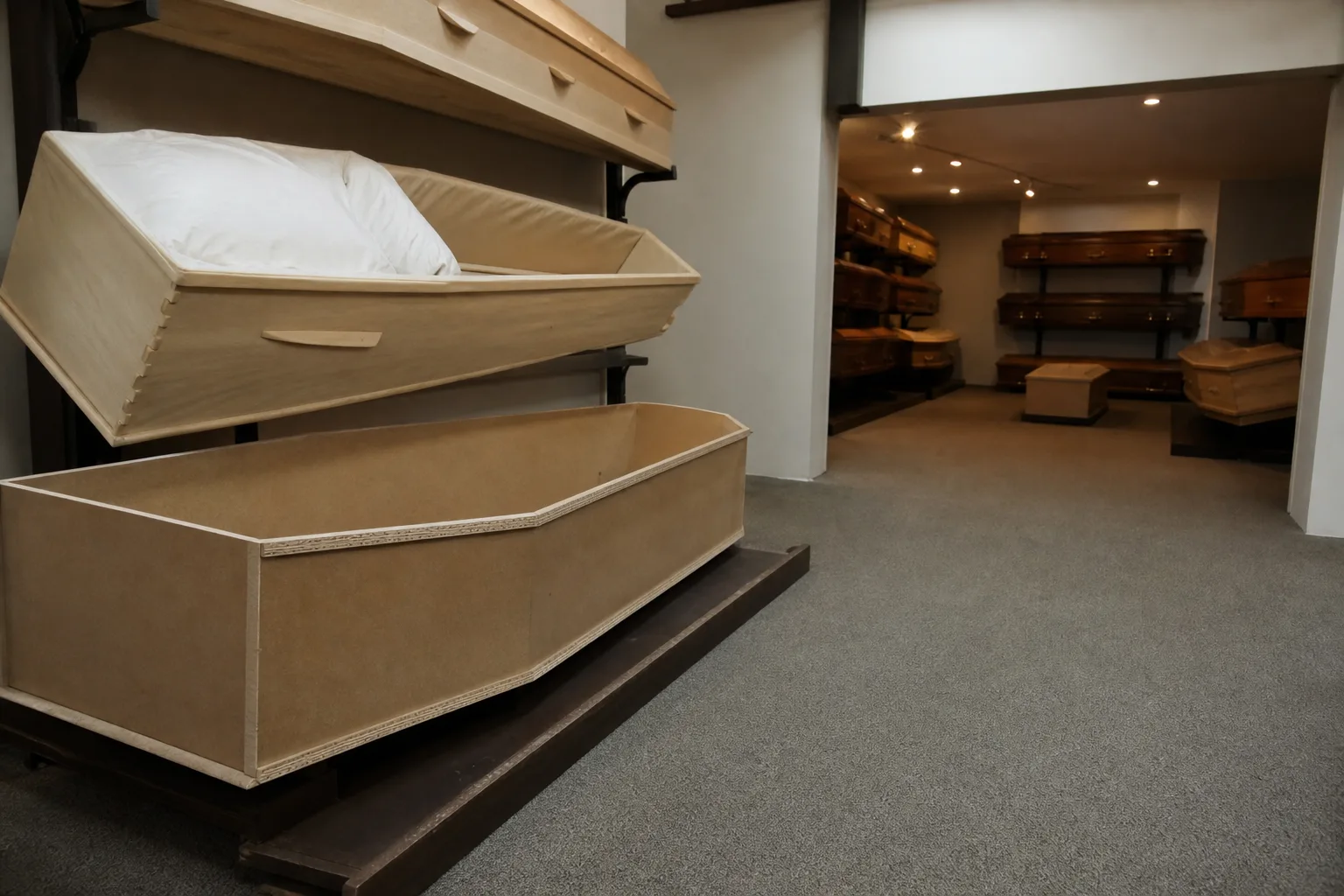
Almost every funeral home keeps a low-priced container somewhere on the price list, and almost none of them keep it in the showroom. It is usually a paragraph of text rather than a display model, described in flat language that gives no sense of what the thing looks like or whether it is adequate for what you need. That gap between the printed list and the room full of polished lids is where most of the avoidable spending happens, and closing it takes about twenty minutes of careful reading and three or four direct questions.
1. The fiberboard container that goes into the retort
For a cremation with no viewing, the container is a rigid corrugated or pressed fiberboard box, sometimes with a plywood base for rigidity, sized to be handled by two people and loaded directly into the cremation chamber. Crematories require a container of some kind: something combustible, rigid enough to be moved without flexing, and fully closed. They do not require a casket. The Federal Trade Commission is responsible for the funeral rule that bars a provider from telling you state law demands a casket for direct cremation, and from refusing to use a container you supply.
2. The unfinished wood box for cremation with a service
Between the fiberboard box and a finished casket sits a plain wood container: pine or poplar, butt-jointed or cleated, unstained or lightly sealed, sometimes with rope handles set into the sides. It costs several times what the cardboard costs and a fraction of what a hardwood casket costs. Families choose it when there will be a gathering with the container present, because it reads as furniture rather than packaging. It also burns cleanly, which matters to the crematory operator, and it accepts a cloth drape or a spray of flowers without looking dressed up.
3. How a rental casket and its inner liner work
A rental casket is a finished shell, usually hardwood, with a hinged bed and an interior compartment built to receive a separate insert. The insert is the actual container: a rigid cardboard or unfinished wood tray with its own lid and its own bedding, and the deceased is placed in the insert, never in the shell itself. After the viewing or service, the insert slides out, goes to the crematory intact, and the shell is cleaned and used again. The insert is included in the rental fee at most firms, though a careful reader confirms that rather than assuming it.
4. What the cemetery requires for a burial
Cemeteries, not states, generally set the rules for burial containers, and most of them care about two separate things. The first is the casket, and almost no cemetery specifies what it must be made of, which means a plain wood box or a cloth-covered composite one is acceptable in the great majority of sections. The second is the outer burial container, the concrete or polymer box that lines the grave and keeps the ground from settling as the casket gives way. That is a separate purchase, often from the cemetery itself, and it is worth pricing before choosing the casket.
5. The four checks worth making before you pay
Ask for the general price list and the casket price list on paper, and read the lowest-priced entries first rather than last. Ask whether the rental casket fee includes the inner liner, and what the liner is made of. Ask the cemetery, in a separate call, whether it requires an outer burial container and whether that container must be bought on site. And ask the funeral home to confirm in plain terms that it will accept a container delivered from an outside seller without adding a handling charge, which the funeral rule does not permit.
The three cheapest lawful options are all real products that people use every week, not loopholes or downgrades, and each solves a different problem: the fiberboard box for a cremation with no gathering, the plain wood box for a gathering where the container will be visible, and the rental shell with a liner for a family that wants the look of a finished casket for one afternoon only. Knowing which of the three fits the plan you already have makes the rest of the conversation short.